|
To download a .pdf of the booklet, Kenilworth: A DC Neighborhood By the Anacostia River, click here. This will take you to friend and booklet-designer Laryn Bakker's website, where you can download the file.
If the link does not work, go here:
http://www.larynandjanel.com/blog/kenilworth_history_booklet_by_joe_lapp.html
A Summary of the Kenilworth History Brochure Project
The “Kenilworth History Brochure” project produced and distributed 1,400 copies of a high-quality, 32 page, two-color, offset-press printed booklet highlighting Kenilworth neighborhood and area history. It also included a Kenilworth history celebration as a community event to kick-off distribution.
The pamphlet gives a broad sketch of Kenilworth area history from the time of the Nacotchtank tribe until the twenty-first century, with special emphasis on the changes of the land and its use, African American history, Anacostia River history, and the formation of public housing in the area. Topics and neighborhood features discussed include the Kenilworth Aquatic Gardens, the Benning Race Track, the Kenilworth Dump, Kenilworth Elementary School, Kenilworth Park, Kenilworth Courts and the tenant management movement led by Kimi Gray, the original Kenilworth subdivision, Douglas Street, Eastland Gardens, and the development of Kenilworth Avenue.
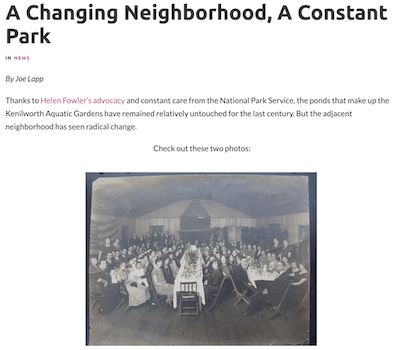
The booklet highlights the experience of individuals within Kenilworth history by incorporating stories gathered through an oral history project with over 35 interviewees and over 100 recorded cassette tapes. It also includes contemporary and historical photos of the area.
The information for this pamphlet was taken from research done by Kenilworth resident and community historian Joseph Lapp. His research included gathering a large collection of news articles about the neighborhood, conducting formal oral history and other informal interviews with residents and former residents, perusing personal papers of residents and former residents, and studying maps and pictures collected from residents and from D.C. area libraries. Mr. Lapp wrote all text for the brochure and procured all the pictures. Laryn Bakker completed the graphic design work. Since there is no published historical scholarship solely focused on Kenilworth, this booklet contains largely new research and material and is the first such collection of historical information focused on the specific history of the neighborhood of Kenilworth, DC.
The community distribution kick-off event was held in the Kenilworth Courts neighborhood and successfully engaged residents from the neighborhood and the larger community, former residents of the area, and interested persons from community organizations and historical groups around the city. This celebration of neighborhood history included a slide show of historical photos and short talks by residents on various aspects of neighborhood history. Approximately 85 people attended this event.
The booklets were distributed to Kenilworth neighborhood residents, former residents, and to interested persons from the larger Ward 7 community. The booklet was also archived at various area libraries and given to historians and to others from around the region interested in the Kenilworth area.
The Humanities Council of Washington, DC (HCWDC) awarded $1,330 in grant funds for printing of the booklet and other project sundries. Cultural Tourism DC provided the non-profit organization sponsorship necessary for the successful HCWDC grant award. Historian Carole Kolker, who holds a Ph.D. in American Civilization from George Washington University and who has experience with community history in DC, advised the writing and production of the booklet. Friend of the project Yoma Ullman provided additional funds for printing and served as primary editor for the booklet's text. Further encouragement for this project came from Ward 7 Councilmember Vincent Gray, the Deanwood history group, local writer E. Ethelbert Miller, and Carl Cole.
For the community event, Denise Stanley and the Kenilworth Courts Resident Council approved use of community space and helped with logistics. Malkia Lydia and Ryan Beiler donated video and still photo documentation. Marshall Heights Community Development Organization encouraged the project and donated use of electronic equipment for the community event. Other DC area businesses contributed in-kind goods or price breaks for the printing of the brochure and for the community event associated with it.
Conducted by a community member who was able to combine an insider's access and knowledge of the neighborhood with a writer and historian's eye for detail and interpretation, this project successfully informed neighborhood and city residents of the history of a sometimes-forgotten community in the under-served area east of the Anacostia River. Dominated by a public housing complex but suffused with a long history of African American home-ownership, the story of the neighborhood was likely to be lost in the new wave of economic development that is now reaching even to the Kenilworth area. By tracing the history of the land and it's people in a small corner of our federal city, this project highlights the vital story of the residential side of the history of Washington, DC. Combining thoughtful volunteer research with a solid connection to the local community, this project illustrates how successful small-budget, community-based historic preservation activities can be.
|